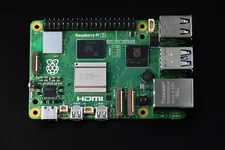
- More powerful CPU: Uses a 64-bit quad-core Cortex-A76 processor running at 2.4 GHz with a 512 KB L2 cache per core and a shared 2 MB L3 cache, delivering around two to three times the performance of the Pi 4's Cortex-A72.
- Upgraded GPU: The VideoCore VII graphics processor runs at 1 GHz (compared with 600 MHz in the Pi 4), giving roughly 2 to 2.5 times higher graphics performance.
- Faster memory options: Launch models come with either 4 GB or 8 GB of LPDDR4X-4267 SDRAM, with 1 GB and 2 GB versions expected later.
- Expanded USB bandwidth: Two USB 3.0 and two USB 2.0 ports can deliver up to 1.6 A to devices when paired with a 5 A power supply and provide more than twice the USB bandwidth of the Pi 4.
- New features and I/O: Includes support for a PoE+ HAT and an on-board real-time clock, a microSD card controller clocked at 800 MHz, dual 4Kp60 HDMI ports, an on-board power button and support for a variable-speed fan to improve cooling.
- Modern power delivery: Uses a USB-C power connector that accepts a 5 V/5 A power supply and supports PD negotiation, providing more stable power to USB peripherals.
These upgrades make the Raspberry Pi 5 a significant step forward for hobbyists, makers and anyone who needs a small yet capable desktop.